The perfect Parisian dinner is drawing to a close. The wine was exquisite, the coq au vin was divine, and the crème brûlée was a masterpiece. Yet, a subtle, creeping anxiety begins to set in as you linger at your table. How do you actually end this experience and pay?
This moment of uncertainty is a common problem for travelers. The fear of appearing rude, using the wrong phrase, or simply being misunderstood can tarnish an otherwise magical dining experience. You’ve navigated the menu, you’ve ordered with your best accent, but now you face the final hurdle: asking for the check in French.
The core of the issue lies not in a language barrier alone, but in a cultural one. Unlike in many other countries where the bill might appear on your table as soon as your plates are cleared, French dining culture operates on a different rhythm. Understanding this is the first step to navigating the end of your meal with the poise and confidence of a local.
Why Patience is a Virtue: The Culture of French Dining Service
In France, a meal is considered a sacred experience, an event to be savored, not rushed. The restaurant staff’s primary goal is to provide you with a tranquil, unhurried environment. From their perspective, bringing the check without being asked is the height of rudeness, as it implies they want you to leave.
This philosophy can feel like neglect to visitors accustomed to more proactive service. Rest assured, the waiter is not ignoring you. They are intentionally giving you space to enjoy your conversation, finish your wine, and relax. In France, the table is yours for as long as you wish, and the power to end the meal rests entirely with you.
This deeply ingrained custom means you must be the one to initiate the payment process. This simple act signals that you are ready to conclude your dining experience. Embracing this cultural nuance transforms the moment from one of potential anxiety into a smooth, controlled part of your evening.
The Only Phrase You Really Need: Getting the Bill in French
While there are several ways to ask for the check, one phrase stands above all others in its clarity, politeness, and universal acceptance. If you learn nothing else, learn this.
“L’addition, s’il vous plaît.”
This is the gold standard. “L’addition, s’il vous plaît” (pronounced: lah-dee-see-ohn, seel voo pleh) translates directly to “The check, please.” It is polite, direct, and understood in every café, bistro, and restaurant across France.
Let’s break it down. “L’addition” is “the check,” and “s’il vous plaît” is the formal way of saying “please.” Using the formal “vous” is crucial as a tourist, as it shows respect. It is the perfect phrase for virtually any dining situation you will encounter.
Slight Variations for Added Politeness
If you want to be slightly more formal or elaborate, you can use a full sentence. “Pourrais-je avoir l’addition, s’il vous plaît?” (Poo-rayj ah-vwar lah-dee-see-ohn, seel voo pleh?). This translates to “Could I have the check, please?” and is a wonderfully polite option for more upscale dining establishments.
Another common and perfectly acceptable phrase is “On peut avoir l’addition?” (On puh ah-vwar lah-dee-see-ohn?). This means “Can we have the check?” It’s slightly more conversational but still uses the polite “vous” form implicitly in most contexts. Feel confident using this in most casual to mid-range restaurants.
First Things First: How to Get Your Waiter’s Attention
Before you can use your new phrase, you need to catch your server’s eye. This is another area where cultural differences can cause confusion. Waving frantically, snapping your fingers, or shouting are considered extremely impolite in France.
The correct method is far more subtle. Simply try to make eye contact with your waiter. Once you have their attention, a slight nod or a small, raised hand is all that is needed. If they are busy, a quiet and polite “Excusez-moi?” (Ex-koo-zay mwah?) as they pass is the perfect way to get their attention without being disruptive.
Avoid the stereotypical movie trope of yelling “Garçon!”. The word simply means “boy” and is considered condescending and outdated when used to summon a waiter. Address your server as “Monsieur” (Muh-syuh) for a man or “Madame” (Ma-dahm) for a woman for a much more respectful and effective interaction.
Navigating the Payment Process: Cards, Cash, and Splitting the Bill
Once you’ve successfully requested the check, the next step is payment. The process in France might be slightly different from what you’re used to at home. Being prepared for these small differences ensures the final moments of your meal are as smooth as the first.
Paying by Card: “Par Carte”
Credit and debit cards are widely accepted. When the waiter brings the bill, simply say “Par carte, s’il vous plaît” (Par cart, seel voo pleh), meaning “By card, please.”
In France, it is standard practice for the waiter to bring a portable payment terminal to your table. You will insert or tap your card yourself and enter your PIN or sign on the screen. Your card never leaves your sight, which is a fantastic security feature. Just being aware of this process can help avoid confusion, which is as important as ensuring your flight status isn’t waitlisted when you’re trying to have a stress-free trip.
Paying with Cash: “En Espèces”
If you prefer to pay with cash, the phrase is “En espèces” (On ess-pess). The waiter will take your payment and return with any change. Handling physical currency is a part of the travel experience, much like packing the right luggage for the journey. Choosing your gear wisely, for instance by comparing brands like Calpak, Away, and Beis, sets you up for success from the start.
The Challenge of Splitting the Bill
Splitting the check is not as common in France as it is in other countries, and it can sometimes complicate things for the staff, especially in a busy restaurant. While not impossible, it’s best to be prepared. The best phrase to use is “On peut payer séparément?” (On puh pay-ay say-pa-ray-mon?), which means “Can we pay separately?”.
The easiest solution, however, is to have one person pay the entire bill and have the others reimburse them later. If you know in advance that your group will need to pay separately, it is considered courteous to inform the waiter when you are first seated. This allows them to keep track of orders separately from the beginning.
Decoding Your French Bill: A Guide to “L’Addition”
When you receive your bill, you’ll see a list of items and prices. Understanding a few key terms can help you feel confident that everything is correct. It’s a small step that, like having your Global Entry details in order, contributes to a smoother overall travel experience.
Most importantly, look for the words “Service Compris” or “Prix Net” printed on the menu or the bill. This is a legally required statement indicating that a 15% service charge is already included in the prices. This has significant implications for tipping.
Here is a breakdown of common terms you will find on a French receipt:
| French Term | English Translation | What it Means on Your Bill |
|---|---|---|
| L’Addition | The Check / The Bill | The total amount you owe for your meal. |
| Service Compris | Service Included | The tip is already included in the prices. No extra tip is required, but a small one is appreciated for good service. |
| TVA (Taxe sur la Valeur Ajoutée) | VAT (Value Added Tax) | The tax is included in the itemized prices. |
| Prix Net | Net Price | The final price, with service and tax included. |
| Boissons | Drinks | The section listing all your beverages. |
| Entrées | Appetizers / Starters | The first course of your meal. |
| Plats | Main Courses | The main dishes you ordered. |
| Desserts | Desserts | The sweet course at the end of your meal. |
| Carafe d’eau | Carafe of water | Free tap water, a great way to save money. |
The Truth About Tipping: To “Pourboire” or Not to “Pourboire”
Tipping culture in France is a frequent source of confusion for travelers. The most important thing to remember is the concept of “service compris”. Since the service charge is already built into your bill by law, you are under no obligation to leave an additional tip.
However, it is customary to leave a small extra amount, known as a “pourboire” (pronounced: poor-bwar), for very good service. The word literally means “for a drink,” which perfectly captures its spirit: it is a small token of appreciation, not a required supplement to the server’s wages.
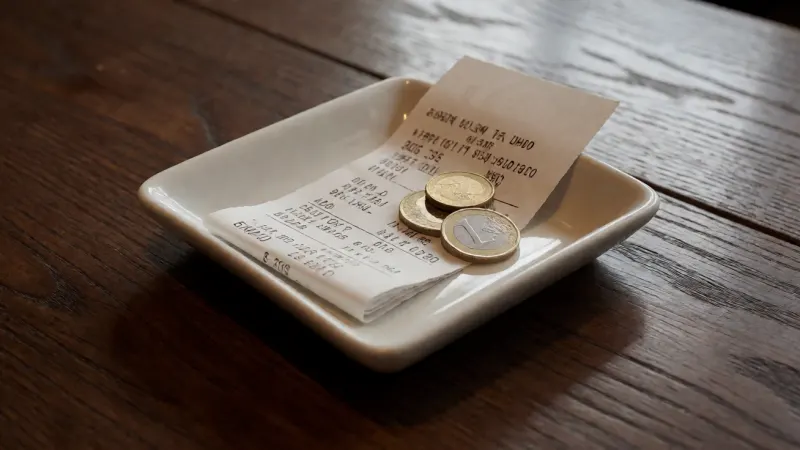
How much should you leave? There are no strict rules. For a coffee or a drink, rounding up to the next euro is common. For a meal, leaving one to five euros in coins on the table is a generous and appreciated gesture. A percentage-based tip, like the 15-20% common in the United States, is not expected and would be considered highly unusual.
A Simple Checklist: Common Mistakes to Avoid
Navigating French dining etiquette is easy when you know the basics. Keep these simple “don’ts” in mind to ensure a polite and respectful experience.
- Don’t be impatient. Remember that service is intentionally leisurely. Relax and enjoy the experience.
- Don’t raise your voice or wave your arms to get a waiter’s attention. A simple look and a nod are sufficient.
- Don’t say “Garçon!” It is an outdated and offensive term. Use “Monsieur” or “Madame.”
- Don’t be surprised when the payment terminal is brought to your table. This is the standard, secure way to handle card payments.
- Don’t feel pressured to leave a large tip. The service is already included in your bill. A small “pourboire” for excellent service is a kind gesture, not a requirement.
Putting It Into Practice: A Sample Conversation
Let’s walk through a typical end-of-meal scenario to see how these elements come together seamlessly.
First, you catch your waiter’s eye and give a slight nod. As he approaches, you are ready.
You: “L’addition, s’il vous plaît.”
Waiter: “Oui, bien sûr. Tout de suite.” (Yes, of course. Right away.)
He returns with the bill in a small tray. You place your credit card in the tray.
Waiter: “Par carte?” (By card?)
You: “Oui, merci.” (Yes, thank you.)
He brings the portable machine to your table, you complete the transaction, and he hands you the receipt. As you prepare to leave, you offer a final, polite closing.
You: “Merci, bonne soirée!” (Thank you, have a good evening!)
Waiter: “Merci à vous, bonne soirée.” (Thank you, have a good evening.)
Conclusion: End Your Meal with Confidence and Grace
Asking for the check in French doesn’t have to be a source of stress. It is a simple interaction, governed by a culture of respect for the dining experience. By understanding that you are in control of the meal’s pace and by equipping yourself with a few key phrases, you can handle the situation with ease.
Remember the golden rule: “L’addition, s’il vous plaît.” Be patient, be polite in getting your server’s attention, and understand that tipping is a small gesture of appreciation, not an obligation. Armed with this knowledge, you are ready to savor every moment of your French dining adventures, from the first bite of your appetizer to the final, confident request for the bill.