The excitement is building. You have a two-week trip on the horizon, a chance to escape, explore, and recharge. But a familiar dread creeps in, a cloud of anxiety that has nothing to do with your destination and everything to do with your luggage.
Choosing a suitcase for a two-week trip feels like a high-stakes decision. Go too small, and you’re forced into ruthless packing decisions and endless sink-washing. Go too big, and you’re wrestling a monstrous bag through airports, paying punishing overweight fees, and unpacking a mountain of clothes you never touch.
This isn’t just about a container for your clothes. It’s about starting your trip with confidence instead of stress. This guide provides the definitive answer, moving beyond generic advice to give you a framework for choosing the perfect travel partner for your 14-day adventure.
Why Your Perfect Trip Starts with the Right Luggage
The wrong suitcase can single-handedly sabotage your travel experience before you even leave home. The stress of packing can cast a shadow over your anticipation, a phenomenon that can sometimes contribute to feeling depressed before vacation. It’s a psychological burden rooted in a few common, costly mistakes.
We’ve all been there, sitting on a half-packed bag, trying to zip it closed while wondering if we’ll need that third sweater for a tropical destination. This indecision stems from a lack of a clear strategy. You’re not just choosing a bag; you’re setting the physical and mental boundaries for your entire trip.
The Overpacking Trap: “Just in Case” Costs You Real Money
The number one mistake travelers make on a two-week trip is overpacking. The “just in case” mindset transforms your suitcase from a tool into a source of anxiety. You pack for every imaginable contingency, bloating your bag with items that will never see the light of day.
This does more than just strain the zipper. It leads directly to airline fees, which are less of a penalty and more of a business model. A few extra pounds can easily tip you over the 50lb (23kg) limit, resulting in fees that can cost more than a day’s worth of your vacation budget.
Size Paralysis: Decoding Liters and Linear Inches
The language of luggage is intentionally confusing. Brands throw around terms like “medium,” “large,” “68L,” and “62 linear inches” without much context. This leaves you standing in a store or scrolling online, completely paralyzed by choice.
What does 70 liters actually look like when packed? Is a 28-inch case considered “large” or “extra-large”? This ambiguity is a significant pain point that leads travelers to either buy a bag that’s far too large or one that’s impractically small.
The Carry-On Fantasy for a 14-Day Trip
While the dream of waltzing through the airport with only a carry-on is appealing, it’s often a fantasy for a two-week, multi-destination, or multi-climate journey. Trying to cram 14 days of clothing, toiletries, and essentials into a 40L bag is an exercise in extreme minimalism that doesn’t suit most travelers.
This fantasy can quickly turn into a nightmare at the gate when an agent determines your overstuffed bag is too large and forces you to check it. Now you’re paying a higher fee and facing the same wait at the baggage carousel you were trying to avoid, all for the sake of a flawed strategy.
The Solution: The “Goldilocks” Size for Two Weeks
For the vast majority of two-week trips, the ideal suitcase is a medium-sized checked bag. This is the “Goldilocks” solution—not too big, not too small. It provides ample space without encouraging rampant overpacking or guaranteeing overweight fees.
This category typically includes suitcases that are around 25-27 inches (63-69 cm) in height and offer a capacity of 65-75 liters. This size is the strategic sweet spot, giving you the flexibility to pack for varied climates or activities without the bulk of a massive “large” suitcase that often exceeds 100 liters.
It’s large enough to hold two weeks of clothing, an extra pair of shoes, toiletries, and any souvenirs you pick up along the way. Yet, it’s manageable enough that you can still navigate train stations and hotel lobbies without feeling like you’re moving furniture. This choice removes the primary source of packing stress.
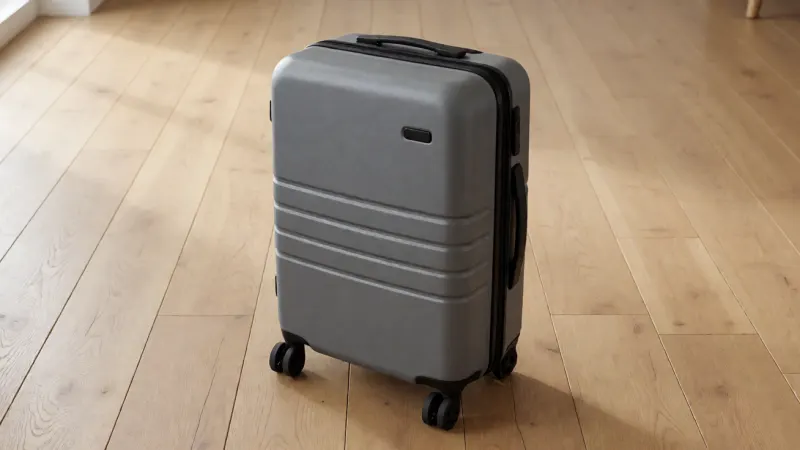
Hardside vs. Softside: The Brutal Truth for a Long Trip
The debate between hardside and softside luggage is fierce, but for a two-week trip involving checked baggage, one clear winner emerges. Hardside luggage, typically made of polycarbonate or aluminum, offers superior protection. Your bag will be thrown, stacked, and tumbled by baggage handlers, and a rigid shell is better equipped to protect fragile contents.
Softside (fabric) luggage has its merits, primarily the inclusion of exterior pockets for last-minute items. However, these pockets are also a target for theft and can be a weak point for water damage during a rainy tarmac transfer. The clamshell design of most hardside bags also forces a more organized packing method, with two distinct compartments.
Modern polycarbonate hardside bags are incredibly lightweight yet durable, debunking the old myth that they are always heavier than their softside counterparts. The sleek, modern aesthetic is a bonus. For the security and durability required on a longer trip, hardside is the more strategic choice.
Spinner vs. Roller: Why 4 Wheels Are Non-Negotiable
This is one of the most critical, yet often overlooked, features. A suitcase for a two-week trip will be heavy. Trying to drag a heavy two-wheeled bag (a “roller”) behind you puts immense strain on your shoulder, wrist, and back. It’s inefficient and exhausting.
Four-wheeled suitcases (“spinners”) are the undisputed champions of airport mobility. They glide effortlessly alongside you, allowing you to navigate check-in queues, security lines, and crowded terminals with minimal effort. You can push them, pull them, or send them spinning ahead of you.
While some argue that two-wheeled bags handle rough terrain like cobblestones better, the reality is that 95% of your time will be spent on smooth airport floors. For that 5% of rough terrain, you can simply tilt the spinner back and pull it on two wheels. The ergonomic advantage of spinners is too significant to ignore for a heavily packed bag.
The 3T Framework: A Smarter Way to Choose Your Suitcase
Beyond size and wheels, you must consider the nuanced details that separate a good suitcase from a great one. The 3T Framework—Trip Type, Traveler Type, and Terminal Test—ensures you evaluate a bag based on your actual needs, not just marketing hype. This is the kind of forward-thinking that can make even a surprise trip from a service like Pack Up and Go feel seamless.
This framework forces you to think about how you will use the bag in the real world. A suitcase is more than its listed features; it’s a tool that must perform under pressure in varied environments.
Trip Type: The Destination Dictates the Details
Where are you going? The answer dramatically changes your luggage requirements. A two-week tour of European capitals has different needs than a fortnight at a single beach resort.
For a multi-destination trip involving trains and varied hotels, a suitcase’s “usability footprint” is key. A slimmer, taller bag is easier to manage in a narrow train aisle than a wide, bulky one. If you’re heading to a destination known for rain, the water resistance of the zippers and shell material becomes a paramount concern.
For an adventure trip, durability is everything. You should look for reinforced corners, sturdy wheel housings, and a robust handle system. For a business or “bleisure” trip, a suitcase with a dedicated suiting compartment or a more professional aesthetic might be a priority.
Traveler Type: Are You a Packer or a Curator?
Be honest about your packing style. Are you a meticulous planner who lays out every outfit, or do you throw things in and hope for the best? Your natural tendency should influence your choice of interior features.
If you are an organized “curator,” you’ll benefit from a suitcase with a 50/50 split clamshell design, allowing you to pack each side with precision. If you are more of a “packer,” a bag with a built-in compression system can be a lifesaver, allowing you to squeeze in more items and cinch them down securely.
Consider your physical strength as well. A lightweight polycarbonate suitcase will be easier for you to lift onto a luggage rack or into the trunk of a car. Don’t just consider the weight when it’s empty; imagine it fully packed at 50 lbs (23 kg).
Terminal Test: Simulating the Airport Gauntlet
Before you buy, perform a “Terminal Test” in the store or as soon as it arrives from an online order. Extend the handle—does it feel flimsy or solid? Does it have multiple height adjustments to fit your stride?
Wheel the bag around. Do the spinner wheels glide smoothly and silently, or do they rattle and stick? Lift it. Is the weight distributed evenly? Are the side and top handles comfortable and well-padded?
Open and close the zippers. They are the most common point of failure on a suitcase. Look for reputable brands like YKK. A sticky or weak zipper is a major red flag. This hands-on evaluation is crucial and can save you from a major travel headache.
Decoding Features: What Actually Matters
The luggage market is saturated with features designed to catch your eye. However, only a few have a real impact on your travel experience for a two-week trip. Understanding these can help you avoid paying a premium for useless gimmicks.
Focus on the core components that affect durability, security, and ease of use. A suitcase is a long-term investment, and prioritizing these elements ensures you get the best value for your money. Below is a breakdown of the features that should be at the top of your checklist.
| Feature | What to Look For | Why It Matters for a Two-Week Trip |
|---|---|---|
| Material | 100% Polycarbonate (not ABS) or Ballistic Nylon | Polycarbonate offers the best blend of impact resistance and light weight. Ballistic nylon is the gold standard for softside durability, resisting abrasions and tears. |
| Wheels | Hinomoto or Lisof Silent Run Spinner Wheels | These Japanese brands are the industry leaders, known for their incredible smoothness and durability. They make navigating the airport a silent, effortless experience. |
| Handle | Multi-stage aircraft-grade aluminum | A telescoping handle that locks into multiple heights is more ergonomic. A wobbly handle is a primary sign of poor build quality and will likely fail first. |
| Zipper | YKK Brand Zippers | YKK is renowned for making the most reliable zippers in the world. A failed zipper mid-trip is a disaster; this is a non-negotiable feature for quality luggage. |
| Lock | Integrated TSA-Approved Lock | An integrated lock is more secure and convenient than a separate padlock. It allows TSA agents to inspect your bag without breaking the lock. |
| Interior | Built-in compression system and smart compartments | A compression pad or straps can significantly increase packing space. Well-placed pockets for small items prevent your bag from becoming a chaotic mess. |
The Financial Equation: Beyond the Price Tag
It’s tempting to opt for a cheap, no-name suitcase to save money. This is almost always a costly mistake. A poorly made bag is a liability that will fail at the most inconvenient time—a broken wheel on a cobblestone street, a failed zipper at the check-in counter, a cracked shell on the baggage carousel.
Investing in a quality suitcase from a reputable brand with a solid warranty is one of the smartest financial decisions a traveler can make. This doesn’t mean you need to spend a fortune, but it does mean prioritizing build quality over a low price. A good suitcase should last for years, making its cost-per-trip remarkably low.
Furthermore, consider the costs associated with luggage failure. Having to buy a new suitcase mid-trip, dealing with the hassle of transferring your belongings, or having your trip disrupted by a broken bag is far more expensive than the initial price difference. And if you’re constantly dealing with overweight bags, it may be time to investigate if services that ship your luggage are a more cost-effective solution for your travel style.
Your Final Checklist for the Perfect Two-Week Suitcase
Choosing the right suitcase for a two-week trip is about eliminating variables and reducing stress. It’s an investment in a smoother, more enjoyable travel experience. By focusing on the right size, materials, and functional features, you can purchase with confidence.
Your goal is to find a travel partner that works for you, not against you. A bag that glides effortlessly, protects your belongings, keeps you organized, and removes the dreaded “what if” from the packing equation. Armed with this knowledge, you are now prepared to make a smart, informed decision that will serve you well on your next great adventure.